
Care has to be designed into the way we decide, listen, and lead.
I remember the time, back in 2018, that I was invited to observe an Belgian organisation that was an early adopter and embodied Sociocracy 3.0:
A governance method grounded in equivalence and collective intelligence.
Inside the building, I am welcomed without hesitation.
Curiosity is not treated as disruption, but as contribution.
People greet each other with attention. Information is exchanged with remarkable precision — no excess, no performance. Just what is needed. Nothing more.
We pass a small room where colleagues sit in a circle on meditation cushions, discussing a driver: a carefully articulated statement of a collective need.
Not a solution.
Not an opinion.
A shared articulation of why something matters.
I watch how listening works here.
Silence is not awkward — it is functional.
Responses are weighed, not rushed.
Care is embedded in the structure.
In the central space, proposals are publicly displayed.
Everyone is explicitly invited to raise possible objections or concerns.
Not objections as resistance, but as information.
This is consent decision-making:
decisions are not driven by dominance or compromise,
but by the question: Is it good enough for now, and safe enough to try?
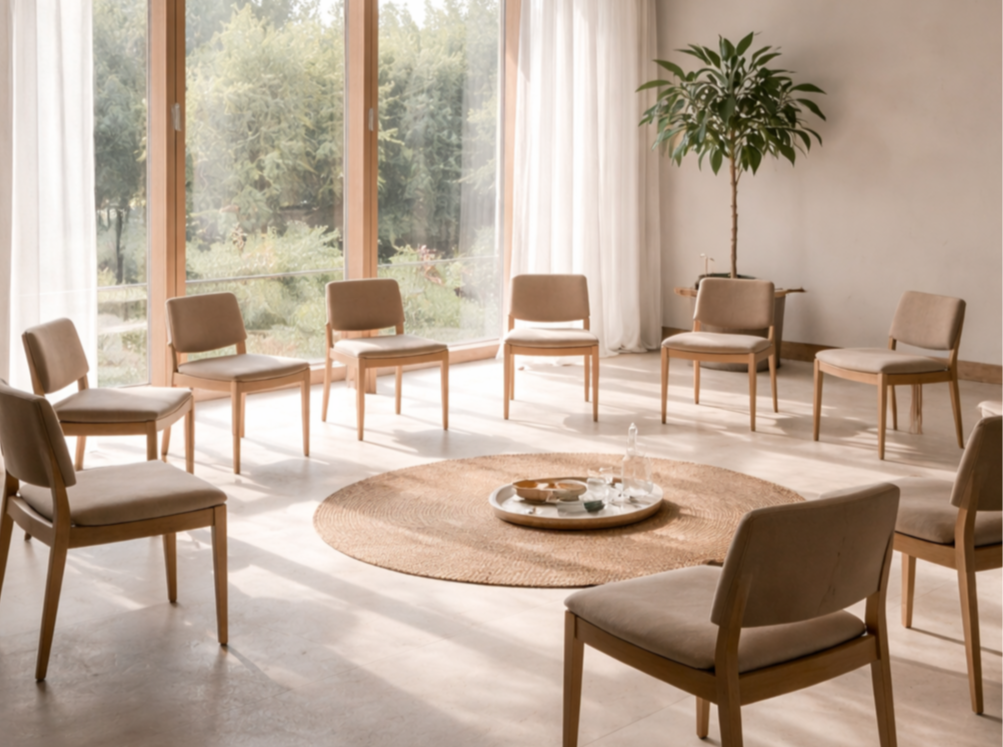
In the meeting room, chairs form an open circle.
A young facilitator asks if it is all right for her to guide the process.
No hierarchy assumed. Authority is granted by mandate, moment by moment.
The check-in begins.
Each person speaks — briefly, honestly.
No one interrupts.
I am invited too.
“I want to change the world,” I say.
“And I suspect this method might be part of the answer.”
It simply lands.
As the meeting unfolds, I notice something rare:
content and care are not competing forces.
The facilitator holds the process, allowing others to fully inhabit the substance.
Different perspectives are not neutralised — they are integrated.
The proposal becomes sharper, wiser, more robust.
Because nobody withholds themselves.
Because it is safe not to.
What I am witnessing is not just an efficient governance model.
It is an ecology of trust.
In the check-out, I am asked how I feel.
“Honestly,” I say,
“this feels like oxygen.”
And I leave knowing this:
If the arts sector is to survive — and remain humane —
care cannot be an afterthought.
It has to be designed into the way we decide, listen, and lead.